
- Details
- Written by: Vic Ramsey
The NCHSAA Board of Directors met on Tuesday & Wednesday, May 5th & 6th, and among many items of business, discussed four proposals submitted by the NCHSTCA. Those proposals were:
- A return to a 16-entry state individual tournament.
- An extension of the postseason schedule from three weeks to four weeks.
- A clarification of the rules surrounding regional seeding meetings.
- A clarification of the rules concerning "small-roster" teams ... teams with three or fewer players.
Our request to attend the Sports Committee meeting in order to answer questions about our proposals was denied.
All four proposals were voted down. Only the postseason schedule proposal made it out of the Sports Committee, and it was voted down by the full Board by a vote of 16-1.
As of this writing, we have not received any formal communication from the NCHSAA as to why these proposals were rejected.
In the interest of allowing our membership to see exactly what was submitted, we are releasing the full text of our submittals.
16-Entry State Tournament
We argued that returning to a 16-entry state tournament was the overwhelming preference of the coaching community, that current facilities were sufficient to host such events, and that doing so would provide more of our student-athletes the opportunity to participate in the state tournament.
This proposal was not advanced by the Sports Committee for consideration by the full Board of Directors.
Click here for the 16-entry state tournament submission form.
Postseason Schedule
We argued that playing the postseason over a four-week schedule would reduce the physical burden on players, reduce the academic impact of multiple classes missed within a short period of time, and provide the NCHSAA with more flexibility to deal with inclement weather.
This proposal was advanced out of the Sports Committee and considered by the full Board, which rejected it on the premise that the 2026-27 was already set, that venues had been contracted for, and that the Calendar Committee could, perhaps, weigh this request as part of its proposal for the 2027-28 sports calendar.
Click here for the postseason schedule submission form
Pre-Regional and Regional Seeding Meetings
We submitted a comprehensive rewrite of the handbook language regarding regional seeding meetings. We argued that the current language was vague and archaic, that coaches should be able to present whatever evidence they wished, including UTR, WTN, or USTA rankings. We also presented several suggestions regarding the construction of the brackets, all of which were supported by a majority of coaches responding to our fall postseason survey.
In the weeks leading up to the meeting, NCHSAA staff contacted us and asked for an abridged version of the language, with the understanding that many of our ideas would be included in a resource document, and not in the handbook proper. We provided that language.
Nevertheless, the Sports Commitee declined to recommend our proposal to the full Board.
Click here for the pre-regional and regional seeding meetings submission form.
Small-Roster Teams
We've identified several teams, in both the men's and women's season, who are playing with three or fewer players, and there is considerable confusion about how these schools are to be accommodated during the regular season. We submitted a proposal to clarify that players from such schools were welcome in the individual tournament, but that such schools would be automatic "opt-outs" for the dual-team tournament (since a 3-player team cannot, mathematically, win a dual-team match.)
The Sports Committee declined to recommend our proposal to the full Board.
Click here for the small-roster teams submission form.
 No comments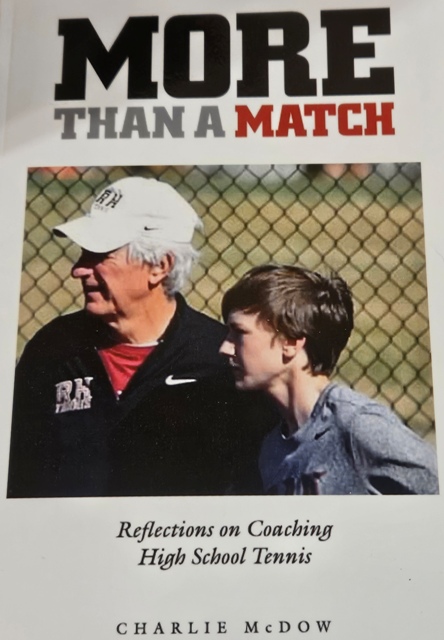
- Details
- Written by: Donald Clark
Charlie McDow, the Rock High School in South Carolina tennis coach from 1976 to 2025, has published a book that covers the basics of coaching high school tennis from A-Z called More Than A Match. Coaches are encouaged to call Coach McDow at 803-389-0047 for more informatoin or to order a book.
- Details
- Written by: Vic Ramsey
As you may recall, at the end of the women's season last fall, the NCHSTCA conducted an extensive survey of the coaching community regarding a number of issues facing high school tennis in North Carolina.
Those results have been tabulated, and we're sharing a "public" copy of the results here on our website.
This report does not include the coaches' responses to the variety of open-ended questions we posed as part of the survey, since we did not have permission to publish those comments broadly. However, we have shared those comments with our Board of Directors,with the NCHSAA staff members responsible for tennis, and with our liason at USTA-NC.
Click here to access the survey results.
- Details
- Written by: Vic Ramsey
Last August, we published the results of our level-based play survey, conducted in May 2025, and our analysis of the playoff results in all sports from 2021-25. You can find that article here.
We've continued that study, looking at playoff results from the most recent fall season in football, men's soccer, volleyball, and women's tennis. We analyzed every contest in which a charter school and a traditional, geographically based high school played against each other. We wanted to see if the move to eight classifications had an effect on the charter vs. traditional competition.
If charter schools, by virtue of being charter schools, have a significant athletic advantage, we should see charter schools winning these contests a majority of the time, by a statistically significant margin, and across all classifications.
Here are the results from the fall 2025 playoffs, in all four fall team sports, in class 1A through 4A, where all of the charter schools reside.
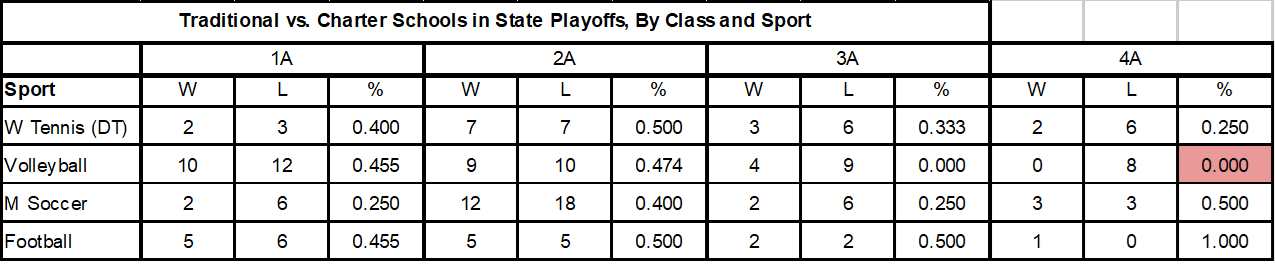
It's early yet ... only one season, after all. So many of the results are not yet statistically significant. Plus, these results are not "independent" ... the same team may be responsible for several wins in a given sport.
All that said, in tennis, the smaller traditional schools (1A and 2A) held their own, but traditional schools in 3A and 4A struggled against the larger charter schools, which are often based in large urban areas. This corresponds to the results of our 2021-25 study, which isolated the disparity in tennis to the 2A classification, and most of those schools now reside in 3A and 4A.